 Albanian
▾
At the beginning of the 18th century, the most perplexing personality in history emerged in European diplomatic circles—a man whose life was so close to being synonymous with mystery that the enigma of his true identity was as unsolvable for his contemporaries as it was for later investigators.
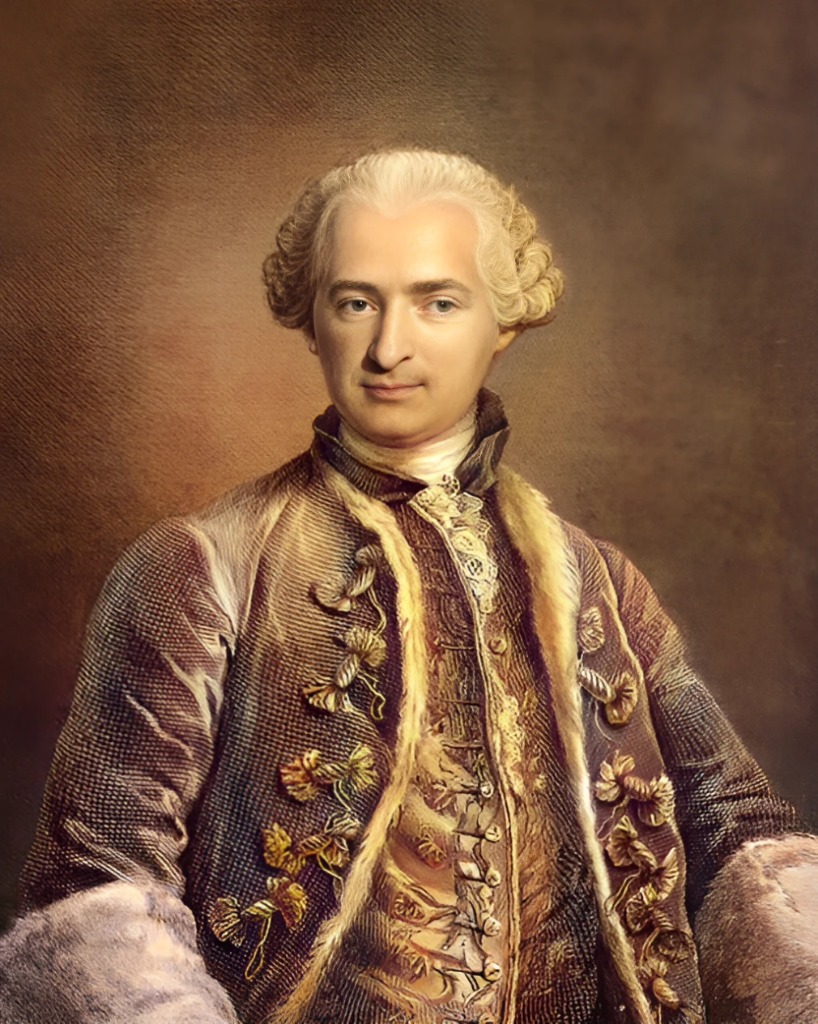
The figure of the Count of Saint-Germain stands out as one of the most enigmatic personalities in the Western esoteric tradition.
Shrouded in mystery, he has been described as a nobleman, alchemist, diplomat, and even an immortal adept.
The Count of Saint-Germain was recognized as the most outstanding scholar and linguist of his time.
Origin of his name
The name “Count of Saint-Germain” appears to be an adopted title, not a proven birth name.
His true identity remains unknown, reinforcing his aura of secrecy and legend.
His versatile achievements extended from chemistry and history to poetry and music.
He played several musical instruments with great skill and, among his numerous compositions, was a short opera.
He was also an artist of rare skill, and it is believed that the remarkably luminous effects he created on canvases were the result of mixing mother-of-pearl powder with his pigments.
He gained worldwide recognition for his ability to reproduce in his paintings the original brilliance of the precious stones that appeared in the garments of his subjects.
His linguistic proficiency bordered on the supernatural.
He spoke German, English, Italian, Portuguese, Spanish, French with a Piedmontese accent, Greek, Latin, Sanskrit, Arabic, and Chinese with such fluency that in every country he visited, he was accepted as a native.
He was ambidextrous to the point that he could write the same article with both hands simultaneously.
When two sheets of paper were placed together with a light behind them, the writing on one sheet exactly covered, letter by letter, the writing on the other.
Origin, era, and possible parents
Saint-Germain’s origins are uncertain and subject to speculation:
Contemporary accounts portray him as a man of refined manners, immense knowledge, and unusual longevity.
Saint-Germain was known as:
He was reputed to possess extraordinary abilities, including knowledge of alchemy, particularly the transmutation of metals and the creation of elixirs.
Mission and Teachings
According to esoteric traditions, Saint-Germain’s mission was:
His teachings emphasized:
In later occult traditions, he is considered an “Ascended Master,” guiding the evolution of humanity.
Writings and Works
There are no confirmed writings directly authored by Saint-Germain.
However, several works have been attributed to him or associated with his teachings:
“The Holy Trinosophy” is considered an allegorical text describing stages of spiritual initiation.
Legacy for Humanity
Saint-Germain’s legacy is both historical and symbolic:
It influenced esoteric movements, including Rosicrucianism and, later, occult schools.
It inspired mystical traditions of the 19th and 20th centuries, among them Theosophy.
It became a symbol of:
His legend continues to inspire seekers of knowledge, representing the ideal of a human being who transcended common limitations.
Conclusion
The Count of Saint-Germain remains a figure suspended between history and myth.
Whether seen as a brilliant polymath, a mysterious diplomat, or an enlightened adept, his story reflects humanity’s enduring fascination with immortality, transformation, and the pursuit of higher truth.