



The first step a person has to take in order to be able to awaken is to accept that he is asleep and we are not talking about awakening from physical sleep, we are referring to the awakening of the consciousness.
It is very difficult for people to accept the idea that they are asleep, because every morning they wake up in their bed and begin performing a series of apparently “coherent” tasks in a state which they consider as “awake“.
Here we encounter a problem in relation to the terms that we are going to use and to the meanings that we are going to give to the word “asleep”.
It is evident that a person when getting out of bed has “awoken” from the sleep of the physical body, but the same thing does not happen at the psychological level.
Generally that person has completed his nightly rest and although the physical body no longer sleeps and is “awake”, on a psychological level the person continues being asleep and goes on dreaming.
People work asleep, dreaming, they drive cars in cities asleep, they marry asleep, they form a family asleep, they make the most “important” decisions of their lives asleep, dreaming, they die asleep, and yet almost everyone believes he is awake.
People usually do not remember themselves and during the day they perform a series of coherent tasks such as getting out of bed, washing their faces and brushing their teeth, shaving if they are men or combing their hair if they are women, getting dressed, having breakfast, going to work, spending 8 hours at work doing their job, returning to their home either walking, driving, taking the bus, the train, the subway, saying hello to their family, having dinner, watching television or sitting at the computer to surf the Internet, sometimes having “sex” and a number of other activities… But in all of this there is a common denominator which is the fact that the person does not remember himself, he is oblivious of himself, and in spite of performing “coherent” tasks the consciousness is absent; that is why we say that man is “asleep” and the person is at best in the second state of consciousness, wrongly called state of VIGIL, but it has nothing to do with VIGILANCE, it is only a variation of the state of SLEEP, it is SLEEP with the physical body awake.
In one of his books the V.M. SAMAEL says: “It is very difficult for the man who returns to his house, after having traveled all over the city, to remember, in minute detail, all his thoughts, ideas, incidents, things, etc. In trying to remember he will discover great “gaps” in his memory, which correspond, precisely, to the states of deepest sleep“.
It is extremely difficult for a sleeping person to understand that he is asleep because normally people are absolutely convinced that they are awake.
But if we perform a small logical analysis and ask ourselves the following questions:
Why can’t we remember our conversations and actions of the previous month, of the previous week and many times of the previous day or of the same day?
Why can’t we remember what we ate yesterday or 3 days ago or 8 days or 16 days ago? Why this haziness?
Why is it that others tell us something and sometimes it is as if we didn’t hear it? Where were we?
Why do we sometimes go somewhere and forget our umbrella, or coat, or any object of personal use?
Why is it that many times a person travels on the bus, or on the subway, and passes by the station where he had to get off? What was he thinking?
Why do we sometimes take the car or go on a trip and forget our personal documents?
Why is it that sometimes when a person is cooking or making breakfast, he forgets the milk on the burner and it overspills, or he burns the food in the pot or in the oven? Why do these things happen?
Why is it that when someone speaks to us sometimes we turn our face and do not listen to what they are telling us? In what world are we submerged?
Why do we forget some of the tasks that we have to perform on the day that begins?
Why does a person sometimes not keep his word?
Why does a person sometimes not attend a previously arranged appointment?
The explanation is extremely simple and convincing: all of this happens because the consciousness is not present, because the person is “asleep”, because there is “self-forgetfulness” and not “self-remembering“.
If the person remembered himself, if he was not “asleep” and “dreaming”, all of this would not happen, because the consciousness is able to inform the person in each moment about what is right and what should be done.
I would like to transcribe in this part of this chapter some teachings in relation to the sleep of the consciousness found in the book “Fragments of an unknown teaching” by the Russian philosopher and Master Piotr Demiánovich Ouspensky, disciple of the Master Gurdjieff.
It is amazing how Ouspensky managed to write down in this book the teachings of his Master almost textually (since he uses quotes), even though he did it years after receiving them.
Ouspensky says, trying to reconstruct the direct teachings of Master G:
“In order to understand what the difference between states of consciousness is, let us return to the first state of consciousness which is sleep. This is an entirely subjective state of consciousness. A man is immersed in dreams, whether he remembers them or not does not matter. Even if some real impressions reach him, such as sounds, voices, warmth, cold, the sensation of his own body, they arouse in him only fantastic subjective images.
“Then a man wakes up. At first glance this is a quite different state of consciousness. He can move, he can talk with other people, he can make calculations ahead, he can see danger and avoid it, and so on. It stands to reason that he is in a better position than when he was asleep. But if we go a little more deeply into things, if we take a look into his inner world, into his thoughts, into the causes of his actions, we shall see that he is in almost the same state as when he is asleep. And it is even worse, because in sleep he is passive, that is, he cannot do anything. In the waking state, however, he can do something all the time and the results of all his actions will be reflected upon him or upon those around him. And yet he does not remember himself. He is a machine, everything with him happens. He cannot stop the flow of his thoughts, he cannot control his imagination, his emotions, his attention. He lives in a subjective world of ‘I love’, ‘I do not love’, ‘I like’, ‘I do not like’, ‘I want’, ‘I do not want’, that is, of what he thinks he likes, of what he thinks he does not like, of what he thinks he wants, of what he thinks he does not want. He does not see the real world. The real world is hidden from him by the wall of imagination. He lives in sleep. He is asleep. What is called ‘clear consciousness’ is sleep and a far more dangerous sleep than sleep at night in bed.
“Let us take some event in the life of humanity. For instance, war. There is a war going on at the present moment. What does it signify? It signifies that several millions of sleeping people are trying to destroy several millions of other sleeping people. They would not do this, of course, if they were to wake up. Everything that takes place is owing to this sleep.
“Both states of consciousness, sleep and the waking state, are equally subjective. Only by beginning to remember himself does a man really awaken. And then all surrounding life acquires for him a different aspect and a different meaning. He sees that it is the life of sleeping people, a life in sleep. All that men say, all that they do, they say and do in sleep. All this can have no value whatever. Only awakening and what leads to awakening has a value in reality.
“So long as a man sleeps profoundly and is wholly immersed in dreams he cannot even think about the fact that he is asleep. If he were to think that he was asleep, he would wake up. So everything goes on. And men have not the slightest idea what they are losing because of this sleep. As I have already said, as he is organized, that is, being such as nature has created him, man can be a self-conscious being. Such he is created and such he is born. But he is born among sleeping people, and, of course, he falls asleep among them just at the very time when he should have begun to be conscious of himself.
“Everything has a hand in this: the involuntary imitation of older people on the part of the child, voluntary and involuntary suggestion, and what is called ‘education’. Every attempt to awaken on the child’s part is instantly stopped. This is inevitable. And a great many efforts and a great deal of help are necessary in order to awaken later when thousands of sleep-compelling habits have been accumulated.
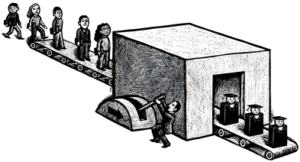
“Man’s possibilities are very great. You cannot conceive even a shadow of what man is capable of attaining. But nothing can be attained in sleep. In the consciousness of a sleeping man his illusions, his ‘dreams’ are mixed with reality. He lives in a subjective world and he can never escape from it. And this is the reason why he can never make use of all the powers he possesses and why he always lives in only a small part of himself”…
The first step to awakening from the sleep of the consciousness is to realize and accept that you are “sleeping”.
When a person accepts that he is asleep, he has taken the first step to begin his psychological self-awakening.
“Self-remembering from moment to moment, is in fact a difficult work, just a moment of forgetfulness is enough to start dreaming“.
“This FORGETFULNESS OF YOURSELF, this NOT REMEMBERING YOURSELF, is really the causa causorum of all human ignorance“.
It is necessary then to analyze in this chapter the mechanism that operates in our psychology which makes the consciousness fall asleep, that is, what the mechanism that leads to psychological sleep is.
IDENTIFICATION – FASCINATION – SLEEP
The V.M. SAMAEL AUN WEOR tells us that he who wants to awaken consciousness must begin by comprehending the three subconscious processes called: identification, fascination and sleep.
To become identified, as the word says, is to become equated with something. And in the daily life of people there occurs a psychological phenomenon through which almost everyone is almost permanently identified with something, which might be, for example, a thought that in a moment passed through one’s mind and then there follows a series of thoughts that occur through psychological associations and takes on life as if it were a movie; the result is that the person ends up thinking about something totally different from the initial thought.
This happens from the moment when the person does not remember himself, falls into oblivion and becomes “identified” with something that caught his attention at the particular moment.
Let us take a look at a practical example: José María, forgets himself, and while working in his office, the thought of a cake with dulce de leche he ate last week crosses his mind.
He becomes identified with that thought, he forgets himself, he no longer remembers who he is, he does not remember his body, and begins to associate thoughts with the initial thought, becoming the Director of a new imaginary film in his mind.
From dulce de leche, he goes to its recipe that his childhood friend Dolores gave him, he begins to think about when he went to elementary school with his friend Dolores to receive his “education“, there he remembers the white uniform with the blue bow he wore to school, the school brings to his mind the neighborhood where he lived many years ago in his hometown, his hometown reminds him of his birth country, the country reminds him of the fine economic situation and the bonanza of 30 years ago, that is associated with the current global economic crisis, with the value of the dollar, the price of gold and oil in the international market… and all this can continue indefinitely for the whole day, every day.
It started with a cake with dulce de leche and ended with the dollar and the global economic crisis!
This is what identification is, which in this example was being identified with thoughts in the mind, but sometimes it happens with a feeling or with a problem and the person spends minutes, maybe hours, sometimes whole days, identified with an emotion or with a problem that he apparently cannot solve. Evidently he has forgotten himself and became identified with the different impressions we receive from life.
Many times the person becomes identified with his work, with a role he must fulfill or believes he must fulfill, sometimes he becomes identified with economic, family, social, health, or various types of problems through the different situations of life.
In these “modern” times in which technology has made huge “advances”, it is very easy to fall in the trap of becoming identified with television, with the computer and remain trapped for entire hours surfing the Internet, where perhaps we initially went to find something in particular, but as in the example of the mind and its thought sequences, the person is hooked from one thing to another and when he realizes it he has already spent several hours watching things that essentially have no importance, forgetful of himself, sleeping beautifully.
When identification becomes deeper and when the person completely forgets himself he passes on to a more intense phase of the mechanism and falls into what the Masters call fascination.
For the person who is fascinated with something, other things do not exist anymore, there is only that which he is looking at or that which he is thinking or that which he is feeling, or the problem that is “preoccupying” him.
And in an even deeper stage beyond identification and fascination, the person, totally forgetful of himself, falls into the sleep of the consciousness, he “sleeps” with his eyes open and with the physical body active, he continues doing all kinds of apparently coherent tasks but sleeping beautifully, and becomes an unconscious spectator of his own mental cinema, where all kinds of subjective films are projected at every moment.
He does not even realize this mental activity, this deep sleep of the consciousness. People are not aware of their own sleep, that is why we said and repeat again that the person who realizes that he spends most of the day “asleep” and that it costs him a great deal to remain in self-remembering even for a few moments, has taken the first step to produce his self-awakening.
One more example of how identification, fascination and sleep happen:
Raymond Sam Sung leaves home early to go to work. As his workplace is near his house, he goes there on foot. On the way, he passes in front of a store where electrical appliances are sold, and a section of the store where they display cell phones of the latest generation attracts his attention. He pauses, forgets himself and the fact that he is heading to work. He starts looking more closely at the phones and becomes identified with them. Little by little the things that surround him disappear from his “consciousness”, identification with the phones becomes deeper and there is one in particular that interests him more than the others. He becomes concentrated on it. He would very much like to have it, he is therefore fascinated by this new phone and having already become identified with this new scenario in which for him nothing else exists, having become fascinated with “his” new phone he begins to dream, completely asleep, but with his eyes open and with the physical body out of bed, on a street in the city where he lives, close to his work. He begins to “see” a movie, where he enters the store (even if it’s too early and the store is still closed), talks to the employee who sells the phones (even though he has not yet arrived), inquires about some of the phone’s technical details, while considering whether he should pay with cash or credit card, talks to the cashier (who has not yet arrived), pays for the phone, receives it in a box (which he will never touch with his physical hands), goes home, opens it, takes a look at it, configures the language, the time, the date, he “sees” transferring all of his contacts from the old phone chip to the new phone, he “sees” himself taking pictures with the 8 megapixel camera of his new phone, and recording some videos which he then transfers to his computer, he sees himself talking to his friends and his girlfriend Solace Internet, and feels very fortunate to “have” a new phone.
Suddenly he has an infinitesimal flash of consciousness and “realizes” that he has to go to work and that he is late. For a few moments he returns to reality, leaves the shop window and continues walking quickly from the appliance store to his workplace, for a few moments he comes back in contact with the real world, but after a few steps another thought passes through his mind, he forgets himself, becomes identified with that new thought, becomes fascinated, and as he continues walking towards his work, he continues to dream, thinking and believing that he is awake just because his physical body is walking down the street.
This situation is repeated throughout the day, every day, in almost all humanity, dying thinking they lived awake and do not realize they have spent their whole life sleeping.
The hypnotic state to which Humanity is subjected is so strong that it is not at all easy to fight against these forces, not even for the people who have already realized the problem and who are trying to awaken and stop sleeping.
There is a real anecdote of a Gnostic student who one day went to his Gnostic Center to do a meditation practice with his group, guided by an Instructor.
He set out to begin the practice, but was very preoccupied because his car had a problem in the gearbox, in the transmission as it’s called in some countries.
At the beginning of the meditation practice after closing the eyes, relaxing and starting the introspection, the very strong thought of the problem with the car came to his mind.
The student became identified with that thought, forgot himself, forgot and disconnected himself from the meditation practice and from the instructor who guided it and began to project an imaginary film in his mind: he went to where the car was, he went to the floor under the engine where the gearbox was, began disassembling it, removing the screws, once disassembled, stopped, opened it by loosening a few more screws that kept it closed, identified the problem inside the box, repaired it, closed it again, put it back in its place in the car and when he heard the words of the instructor saying: “We will now conclude the meditation practice…“, he realized he had remained throughout the practice, not only identified, but fascinated and totally asleep, “repairing” his car!
SOMNAMBULIST – ZOMBIE
These teachings about identification, fascination and sleep were delivered by our Masters a few decades ago, in the past century, but with the passing of time the situation of our Planet has been aggravated, it is much more dense on a psychological level, it has changed and become much more “grave” or much heavier, to put it in some way.
I dare say without fear of being mistaken that in the current times, in the year 2016 of the Christian era, we could speak of two new “states” of the process of sleep that are even more profound than the psychological sleep we have talked about so far in this chapter.
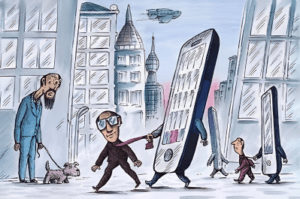
There are times when the state of sleep goes so far and becomes so deep that the person seems like a somnambulist, that is, a person who can move his physical body while asleep and sometimes when the sleep of the consciousness reaches unsuspected limits the consciousness falls into a state that could be called “zombie”, a fictional term which designates a corpse that for some reason returns to “life”, it would be something like a walking dead.
To ascertain what I am saying, it is enough to observe with a little attention the movement of people in big cities, how they cross the street, or in the waiting rooms of an airport for example, where everyone is found with their heads down looking at their cell phones. There we see many people who look like sleepwalkers and when the case is very severe they look like “zombies”.
To conclude this chapter we shall once more site some teachings of Master G regarding identification:
“This in its turn is connected with one of the fundamental characteristics of man’s attitude towards himself and to all his surroundings. Namely, his constant ‘identification’ with what at a given moment has attracted his attention, his thoughts or his desires, and his imagination.
“‘Identification’ is such a common quality that, for purposes of observation, it is difficult to separate it from everything else. Man is always in a state of identification, only the object of identification changes.
“A man identifies with a small problem which confronts him and he completely forgets the great aims with which he began his work. He identifies with one thought and forgets other thoughts; he is identified with one feeling, with one mood, and forgets his own wider thoughts, emotions, and moods. In work on themselves people are so much identified with separate aims that they fail to see the wood for the trees. Two or three trees nearest to them represent for them the whole wood.
“‘Identifying’ is one of our most terrible foes because it penetrates everywhere and deceives a man at the moment when it seems to him that he is struggling with it. It is especially difficult to free oneself from identifying because a man naturally becomes more easily identified with the things that interest him most, to which he gives his time, his work, and his attention.
“In order to free himself from identifying a man must be constantly on guard and be merciless with himself, that is, he must not be afraid of seeing all the subtle and hidden forms which identifying takes.
“It is necessary to see and to study identifying to its very roots in oneself. The difficulty of struggling with identifying is still further increased by the fact that when people observe it in themselves they consider it a very good trait and call it ‘enthusiasm’, ‘zeal’, ‘passion’, ‘spontaneity’, ‘inspiration’ and names of that kind, and they consider that only in a state of identifying can a man really produce good work, no matter in what sphere. In reality of course this is illusion. Man cannot do anything sensible when he is in a state of identifying. If people could see what the state of identifying means they would alter their opinion.
“A man becomes a thing, a piece of flesh; he loses even the small semblance of a human being that he has.
“In the East where people smoke hashish and other drugs it often happens that a man becomes so identified with his pipe that he begins to consider he is a pipe himself. This is not a joke but a fact. He actually becomes a pipe. This is identifying.
“And for this, hashish or opium are entirely unnecessary. Look at people in shops, in theaters, in restaurants; or see how they identify with words when they argue about something or try to prove something, particularly something they do not know themselves. They become greediness, desires, or words; of themselves nothing remains.
“Identifying is the chief obstacle to self-remembering. A man who identifies with anything is unable to remember himself. In order to remember oneself it is necessary first of all not to identify.
“But in order to learn not to identify man must first of all not be identified with himself, must not call himself ‘I’ always and on all occasions. He must remember that there are two in him, that there is himself, that is ‘I’ in him, and there is another with whom he must struggle and whom he must conquer if he wishes at any time to attain anything. So long as a man identifies or can be identified, he is the slave of everything that can happen to him. Freedom is first of all freedom from identification”.